Monday, 14 June 2010

Palmyra and hawkers

Wherever you go in Syria, you are likely to meet a persistent sales patter from some of the most determined hawkers we have met outside of Egypt.

Van in front of coach

On most occasions, whenever our coach stops to let us off to see something, go to the toilet or simply stretch our legs, a car / van quickly appears and (as in this case) parks very close to the front of the coach so that whatever it is selling can be shown (in this case some rather dodgy dates).

Climbing rocks

The fact that we were sitting on the top of a hill watching the sunset was not going to stop this hawker coming up the hill and offering us again what he had offered as we passed him at the bottom of the hill.

Hawkers following tourists

It is not unusual for a hawker to follow you around a historical site on their motorbike, stopping whenever you are listening to an explanation and offering you the chance to reconsider your earlier decision not to buy whatever they are offering.

They usually sell with a certain amount of humour and enjoy the bartering process. We accept that whatever the price we pay, it will be more than that paid by a local – as a rule of thumb, we try to finish the barter process paying 60% of the original asking price. It is fatal to show too much interest, if you do you are seen as an easy sell and the asking price might not drop at all.

In many of the towns, shop owners are very keen to get you into their shops even if the products are obviously of no interest to you. Never-the-less, they are always willing to spend time explaining their wares even if no sale is likely to take place. It has been a delight to learn about soap, spices and silks etc from some of the shop owners in the Syrian Souks.

Palmyra

image


Some 250 kms north west of Damascus on the road to Iraq lies one of the archaeological wonders of the world which has long been on our visit list. On the way there, it is brought home to us how close we are to Iraq, not only by the Road Signs

Road to Baghdad 2 

Road to Baghdad 1

but also by the name of the Road House “The Baghdad Cafe” which we stop at for a toilet break and coffee.

Baghdad Cafe

Never-the-less, we have always felt safe.

Palmyra (historical name Tadmor) is large – the photo below was taken from about 10 kms away and shows the extent of much of the city walls

Palmyra Site

It was built here because of an Oasis and the fact that it was on a cross roads for travellers from the far east through to the middle east. Its wealth came from taxes charged, anything up to 25% of the value of the goods passing through. If you are interested in its history and dates, then Google. It has been said that it was first built by King Solomon and certainly dates from around then. It was wealthy before the Romans came on the scene and eventually captured Queen Zenobia and took her back to Rome supposedly in “chains made from gold”.

A slightly closer photo shows the central temple and the famous colonnaded street .

Palmyra 1  

In the centre of Palmyra is the huge temple of Ba'al

Temple of Baal

It is heyday, it was a colourful building, the colours have been

What the temple looked like

determined from fragments of colour which still exist on some of the

Freeze Remnant

Freeze Colour

remnants. Inside the temple are two side altars (the temple was also

 Baal Temple Roof Carving

used as a church later on). The beauty of the ceiling

Baal Temple Roof Colours

and the privilege of seeing it some 2000 years after it was carved are both hard to express. All of the pillars in the temple (and most of those

Acanthus Boss

elsewhere on the site) have bosses decorated with carved Acanthus Leaves. The temple itself is massive showing how wealthy the city was.

Massive Temple Site

Other highlights of this amazing city are the Theatre
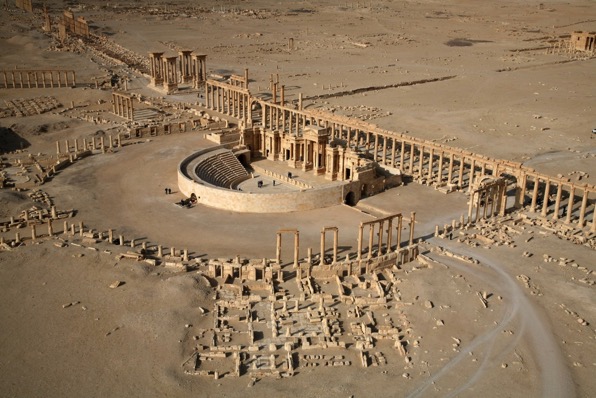
Palmyra

which although parts of it have been extensively restored, shows exactly how it originally appeared.

Theatre 1

Of course it had perfect acoustics and it is estimated that it could seat around 3000 people

Hot Travellers

including these two explorers who were both hot and tired having walked along its famous colonnaded road.

Palmyra Columned Road

Much of the city was decorated with statues or wall reliefs of its citizens. The best were inside the city museum (which of course we were not allowed to photograph) but this one below, which was outside

Carved Image

shows the quality of the images.

Outside of town is an interesting example of ancient private storage facilities – a sort of “Big Yellow Box Warehouse” of 100 BC.

Burial Tower Valley

There is a valley near the city which is full of towers, some 60 have

Burial Towers

Burial Tower

been discovered so far.  The best of them has been restored. Its use was a storage place for coffins. Upon death, a space would be rented for 5, 10 or 15 years and the coffins stacked inside the warehouse in niches on the various floors.

Burial Spaces

The coffins were stacked some 8 high and a typical coffin storage warehouse would store some 400 coffins. Inside they were richly decorated as can be seen from this ceiling fragment.

Decorated Coffin Ceiling

At the end of a long, hot day, the sun sets over the desert and our

Sunset over the dessert

travellers go to bed.

Sunday, 13 June 2010

Damascus

Damascus is said to be the oldest continuously inhabited city in the world (along with a few others) and Syria being one of the ancient crossroads between East and West has many claims on significant event in history. Hence, there is a lot of history to see.

One might imagine that the Damascus National Museum would be a good place to start but when we visited about half of it was closed for refurbishment and as is common to most museums in Syria, you are not allowed to take any photographs inside (no one, not even the guides could think of any logical reason) – hence we cannot show you very much.

Proving that you cannot do much when thinking of a new design for a bath, we have this Roman Bath which is identical in design to that in our house in England.

Roman Bath 

Dumped in the museum gardens were two very nice sections of Roman Mosaic

Mosaic Woman Mosaic Man

and rather a nice fish

Mosaic Fish 

and then two Animals for Sam – do you know what they are?

Horse for Sam

Lion for Sam

The most important work inside was a clay tablet with 30 cuneiform characters on it dating from around 1400 BC. These are said to be the origins of around 10 different alphabets including that used in this blog. We cannot of course show you this tablet so if you want to see it click here and scroll down until you find the image on the right hand side.

Ugarit_0002

However, the above chart does show how 15 other alphabets are related to the original Ugarit alphabet shown on the clay tablet.

Damascus is full of small workshops and shops, here we have a glassblower showing how easy (!) is is to blow a glass vase

Glass Blower 1 

and here is a Jacquard loom (invented in 1801) still in use making fine silks. Computer historians will remember that it is one of the first examples of a programmable machine, the pattern being controlled by the “punched wooden cards”. Its invention enables semi-skilled workers to produce patterns designed by others. To change the pattern, you change the card.

Jacard Loom Programme Jacard Loom

The old town (a Unesco World Heritage Site) lives up to its name and is an amazing place full of

Old Town 1 Old Town 2

alleyways with buildings designed to overhang every space

Old Town 3

and shops or cafes tucked into every corner.

Old Town Pat Lunch

There are numerous street side cafes selling food and drink, lunch cost around £2.

The Souk in the old city is an absolutely amazing assault on the senses. It is full of thousands of small shops selling everything you could and might not want. There are clothes shops

Shop 1

Shops selling head scarves

Shop 3

mix it yourself perfumes

Dried Fruit

places to buy Olive Oil soap

Spices 1

Herbs and spices galore

Spices 2

Sweets probably laden with e-factors

Sweets

and when you get tired, you can have a drink from a Tamarind  (aka Indian Date) drink seller who fills your cup with great performance

Date Driink

and Damascus’s most popular ice cream house

Ice Cream Shop

which of course we had to try

Ice Creams

Ice Creams Pat

The Souk is also the start of “Straight Street” which is mentioned in the Bible as having been travelled by St Paul and he stayed in a house on it. The section we walked was in the Souk.

Pat Straight Street Straight Street Sign

It is quite strange to be there and to think “St Paul Walked here” (although he would not have seen the Souk).

One of the “must see” sights is the Umayyad Mosque built from 705AD. But before you can go in, you have to be appropriately dressed.

Pat donning Cape Pat and Paul Cape-1

and so Pat (as a woman) had to cover herself with an all encasing robe and I (as a man wearing shorts) was asked to wear a voluminous lower tunic style skirt. 

The mosque is the burial place of Saladin (famous for his battles with Richard)

Tomb of Saladin Tiles in Saladin Tomb 

and is a quite amazing place, both in terms of its scale and its artistry.

Mosque 4

Mosque 3

The Alms House where donations are stored.

Mosque 5

A decorated ceiling

Head of JB

Inside the mosque, where unusually (for us at any rate) there is a shrine which houses the “head of John the Baptist”. Whilst here we have been told a lot about the various branches of Islam, their particular beliefs, how the religion works on a day-to-day basis etc. I think it would be true to say that we still find it somewhat confusing.


Jabri House Dinner

Wealth and style are usually shown on the inside rather than the outside in Damascus and this restaurant (where we ate one night) is housed behind the most innocuous of doors down a side alley.

The World Cup is of course followed here with as much interest as at home and wherever you go, televisions are tuned in to the games. All around the walls of this restaurant were large screens showing Germany playing New Zealand. In general the Syrians were supporting Germany (who won 4-0) much to the quiet but resigned dismay of two New Zealanders in our group.

Saturday, 12 June 2010

The Middle East beckons

When we were students (too many years ago) we hitch-hiked around the Middle East covering Turkey, Iran (really wonderful) and Iraq (not so wonderful). What we got up to and the risks (as would be judged today) we took are now best forgotten. Although we crossed Syria, we never saw any of it and made a resolution to return one day with Damascus and Palmyra being high on the list. Add to that a desire to visit Petra in Jordan and you

image

have all the ingredients of a journey. In this case, we are travelling with Exodus who specialise in holidays for travellers rather than tourists and offer only about six trips to Syria each year.

Lonely Planet has an interesting comment on Syria: Here's a newsflash: contrary to what the US State Department may wish the world to think, Syria is not populated by terrorists, zealots and other bogeymen. In fact, Syrians are among the most friendly and hospitable people in the world, and most visitors to their country end up developing a lifelong infatuation with its gentle charms. The reaction of most people when we said we were going to Syria and Jordan varied between “you must be mad” and “what do you want to go there for?” Certainly we do not know of anyone else in our circle of friends who has been there.

And so we are again making the trip out to Heathrow in order to catch a

On the train to Airport

late afternoon flight to Damascus where we will meet the others in our small tour group. When we check-in at Heathrow we find that we have been upgraded to Business Class and so the pleasures of the Business Lounge, nice wide

Business Lounge

seats with plenty of leg room and an upgraded menu await us. With two crew to look after eleven  Business Class passengers (two for 140 in economy class) we force ourselves to enjoy the champagne, hot towels,

BMI Menu

menu of your choice, newspapers, better choice of films etc

Business Class

Arriving in any foreign country late at night is always a strange experience and Damascus is no exception. There is a surprising lack of formality, the stamp in our passport is unimpressive, our bags are waiting us and slowly the other members of our 15 strong band assembles under the eye of our guide Adnan who, on the way into town, proceeds to tell us more than we can absorb – bed is all we really want. One thing which we both notice is that Damascus is still very alive at 1 am in the morning. If you wanted to go and buy a new kitchen just after midnight, there are shops open and ready to serve you and lots of small children are still up and lively. They are also repairing the roads, selling t-shirts on the pavement and many families are sitting on the grass beside the main road into town having a picnic.

That one is in a country which has firmly positioned itself on one side of

Map of Syria

the continuous unrest within the Middle East is shown by the map above – notice the area called Palestine and note also the country whose name is missing.

There are quite firm official opinions about Britain and the USA and whilst tourists from these countries are welcomed, at an official level whenever possible, economic sanctions are enforced. For example, there are no car or lorry dealerships selling UK or US built cars and they do their best to avoid by products from these countries but of course it is not always possible.

Anyway, we have arrived safely and somewhat hot – more to come.