Saturday, 28 May 2011

Dives 13 and 14 – Kandooma Thila - South Male

The plan was to repeat dive the site from earlier in the week but to approach it from the other direction so that we

Kandooma Thila Dive Plan

were creeping up on the Shark Cleaning Station from the channel rather than the blue. Negative descent down to 15m, reef on right shoulder, go with the current, hook on at overhangs to watch fish, proceed down to cleaning station to see the sharks at 25m then up over the Thila for safety stops, pickup out in the blue. However….

We were dropped off too far from the reef and the current was so strong and the viz so poor we could not find it. So after 15 minutes of trying, it was back onto the Dhoni to reposition and try again.

Attempt two got us closer to the reef

Reef Hooking

and we managed to hook on but the viz at 25m was 10m at best and we could not see the sharks and they could not see us so we gave up and ascended to look at reef life (and where coincidently the current was not as strong).

Two Jacks going away

Lots of fish not particularly interested in us.

Turtle in cave

A turtle hiding under a ledge

Turtle leaving cave

which came out when it realised we were watching

Asparagus Coral and Fishing Line 

Asparagus Coral entangled with a fishing line

Nice Coral Nice Coral 2 Nice Coral 3  

Three rather nice bits of coral life showing the variety and colours.

This single dive turned into two dives and still did not achieve the original dive plan. After four attempts on this reef, we decided to move on – the shark cleaning station would have to wait for a return visit.

Dive 12 - Kunaavashi Kandu revisited – Felidhe Atoll

The nearest Atoll to the dive site is a Picnic Island

Picnic Atoll

so called because it is visited by picnickers and has no official residential accommodation.

This time the plan was to reef hook further out and deeper into the channel in order to see the early morning sharks.

Dive Plan-1

Depending on the current direction, we would either drift across the mouth of the channel and make for the southern wall or drift in and hook wherever it was possible.

In the event, the current was strong and swirling and we drifted into the channel rather than across it. There was a ridge line at about 32m to which we hooked on in the strong current. For me, the maximum depth became 34.1 (deeper than the dive plan but above the maximum Nitrox depth for 29%) and the hang out time at around 32m was18 mins. Avoiding turning the dive into a deco dive was difficult and most of us went into a short compulsory deco time which for me was expended by slowly ascending towards 20m towards the end of the dive and my Suunto D4 gave me its usual additional 1 minute penalty at 3m on top of the standard 3 minute stop.

White Tip 2 

We did see lots of sharks and there were numerous White Tips around which were quite interested in us

White Tip 1

but usually kept their distance.

Shoal at 30m

Shoals of fish went into line ahead formation to minimise the effects of the current and to minimise the individual chances of being eaten by a shark.

When we released our dive hooks, we were swept along by the fast current.

This video shows the speed of the drift and further evidence of the speed is given by the angle of the air bubbles which are not going straight up as they would if there was no current.

Feather Star 2  

Just to show it was not only sharks, here is a feather star

Turtle

and a turtle seen some distance away.

Friday, 27 May 2011

Dive 11 – Kunaavashi House Reef – Felidhe Atoll

Kunaavashi House Reef Dive Plan

This was a night dive off a house reef but this time without bright lights from a jetty. It became a difficult dive when my dive torch failed (the seal seemed to fail and it let in water) and also when my buddy disappeared and I then had to join a different group, one of whom (towards the end of the dive) lent me their spare torch.

Never-the-less, it became a good long 60min dive with a great small squid plus a turtle and my flashing strobe was invaluable on the surface.

Turtle in Nest

Here is a turtle hiding in a cave / under a ridge.

Turtle

It felt disturbed by our presence and headed out into the blue followed by torches for some distance.

Corals 

There were the usual corals

Squid Illuminated

and a group of small squid

Squid 1

which appeared rather beautiful when illuminated from below.

Squid 2 

You could see them pulsate as they propelled themselves along.

This was a 60 minute dive, slightly taxing because my Buddy was not there when needed but it was easy to join up with another group – moral of the lesson: get a new Buddy and buy a second torch to take when night diving (although I did have my Strobe with me for use on the surface).

Dive 10 – Kunaavashi Kandu - Felidhe Atoll

All liveaboard boats in the Maldives seem to be accompanied by a Dhoni from which the actual diving takes place -  the boat itself acting as a floating hotel with functions limited to feeding, sleeping and transportation from one site to the next. This is in contrast to the Red Sea for example, where liveaboards have a dive deck at the back of the boat. My view is that there are a few advantages and many disadvantages to the Dhoni system but this is how they do it so you just have to live with it.

Dhoni at Sea

Dhoni is a Maldivian word meaning a general purpose boat. They are typically about 15 metres long, low powered and possibly a little top heavy – hence they roll in the sea.

Dhoni - ready to dive

Their main advantages are that they are manoeuvrable and have lots of space and so when you are kitting up you are not treading on the toes of other divers and they can steer

On Dhoni after dive 

their way around and through the numerous atolls which no doubt would cause problems for the larger liveaboards.

The routine on our boat was that once the briefing was over, everyone got onto the Dhoni and started assembling their gear and the Dhoni set sail for the dive site.

Entry is always Giant Stride off either side

Dhoni arrives for pickup

and pick-up involves swimming to the Dhoni, taking your fins off in the water and climbing up a standard ladder.

Dhoni Pichip technique 

After the dive, your equipment is re-fixed into position and usually the cylinders are taken to one side to be unloaded for refilling.

Disadvantages include the fact that this process slows down the diving routine and therefore it would be hard to fit more than three dives into the day unless you started at dawn and had shorter surface intervals (thus reducing depth or increasing Nitrox levels), refilling cannot start until the Dhoni has got back to the mother ship (since it has no compressors on board), and they are slow and underpowered. This latter disadvantage stopped us crossing the channel to South Mali one day and the Liveaboard had to turn around because the Dhoni could not keep up in the strong headwind and choppy seas we encountered. They are too big to be towed and hence have to make their own way behind the mother ship.

Dive 10 was supposed to be Ari Atoll in the west of the Maldives. To get there we had to cross the channel between the eastern and western sides which took about 4 hours but……

we set sail in calm weather followed by the Dhoni with the intention of looking for and snorkelling with Whale Sharks when we arrived and then diving. However the weather rapidly changed to really heavy monsoon rain, visibility went and the seas got up so much that the Dhoni started lagging behind, got out of sight and then lost radio contact with us.

The dingy being towed behind the Orion started to

Sinking

sink so two hapless crew members were put into it to bail like fury for two hours until we reached Ari Atoll. It then transpired that the Dhoni with all of our dive gear on it had been forced to turn around for safety reasons (it was in danger of sinking like the dingy above) and we had no option but to have lunch and go back east roughly to where we started the day without any diving.

The further revised revised plan now is to get somewhere east late this afternoon, perhaps two dives today, four tomorrow (Saturday) and three morning dives on Sunday (to give us 24 hours surface time before the flight on Monday). We have all been offered a $200 discount on a future trip (but no free beer which would have been nicer)which we are advised to take in late October or March to “guarantee” seeing Whale Sharks. They said this was only the second time they have had to abandon going to the western atolls. Naturally we are all disappointed but there is no point in letting this ruin the trip and more dives per day are planned. One of our number “knows people who may know where Mantas are right now” so when we get back within phone range, he is going to find out where they are and we may head in that direction. Everyone on board fits into the category of a “hard core diver” so provided we get some good dives we shall feel somewhat better although of course we are disappointed. Ironically, the weather was very good on the way back!

Obviously the Dhoni is again the source of our problems but apparently all dive boats out here bar two use Dhonis and the two which do not (and operate up north out of the whale shark areas) are said to be never full because Maldivian clientele prefer Dhonis (not me though!)

Dive 10

Kunaavashi Dive PLan

The plan was to descend fast to around 25metres, hook and look for sharks and large fish.
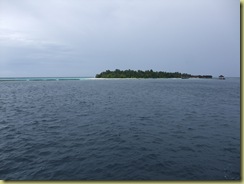
Atoll near Kunaavashi 

The reef is off the standard Maldivian Island

Speed of CUrrent

The current was strong (3 knots minimum) as can be estimated from the angle of the air bubbles rising to the surface in this picture (mathematicians can calculate the vector if they want to prove this),

WHite Tip 1

There were numerous sharks, mainly White Tip

WHite Tip 2

patrolling up and down, giving us the eye.
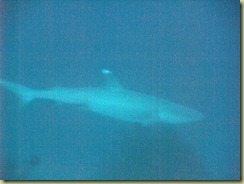
White Tip 3

I have become a big fan of Sea Cucumbers so here is a different variety to that which I usually see
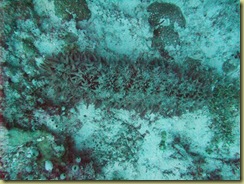
Sea Cucumber

A hard dive in a strong current but good sharks.

Thursday, 26 May 2011

Dive 9 – Alimatha Felidhe Atoll

This was scheduled to be the only night dive of the week, the revised plan being three dives per day and two on the last day and maybe a swap of one dive for snorkelling with Whale Sharks if they are found later on in the week.

Dive Plan Alimatha-1

Alimatha is an island with a hotel and the usual tourist facilities which included a pier with bright night lights shining down onto the water.  Hence lots of big fish were attracted to the lights to hunt.

As usual, there is a strong current, this time off the shore and heading to the right of the dive plan. So it was a giant stride off the Dhoni to the left of the pier, drift to the area of the pier, reef hooks out so you could hang around before drifting further down the beach for a pickup from the Dhoni in the darkness.

Close Ray

Immediately we were in the water we were surrounded by large fast moving rays which came very very close, sometimes between our legs or over our arms. Rays of length approaching 2m were common and the barbs on their tails were easy to see and avoid.

Close Ray 2 

The currents and the fish stirred up a lot of sand and hence there was a lot of back scatter from the lights.

Fast Ray Fast Ray 2 Fast Ray 3

These three images were snatched as fast rays zoomed by carefully avoiding us and our reef hooks. No matter how close they seemed to be coming, no ray hit any of our dive group.

Jack hunting

As well as Rays, there were large numbers of Jacks

Jack hunting 2

hunting for food – typical lengths would be 1m and numerous reef and Black Tipped Sharks circling us a little way out attracted by the lights and hoping for easy smaller fish for tea.

Lion Fish

The ubiquitous Lion Fish was of course present and the usual care had to be taken to ensure they did not hide under divers in order to make their hunting easier.

Snails

As well as macro beasts, there were numerous small fish and above a couple of snails getting very close together under the spot lights – discovered during an intimate moment!

Upon surfacing, it was then time to put on our flashing beacons and illuminate our SMBs so that the Dhoni could see us and come by for a pickup.

This was a great shallow night dive, probably the best I have had and everyone of the boat came out of the water excited with what they had seen.

Dive 8 – Miyaria Kandu Felidhe Atoll

Miyaria Kandu Dive Plan

There are three dive plans for this site depending upon the current direction and strength – the first plan if the current is flowing out (bottom to top of plan) is to enter the water at the northern end (bottom left of plan) and head towards the reef face at 24 metres where there are often sharks – hook on because the current will be mild to medium and in an updraft due to the reef face and watch the action, then fin across the current to the east before drifting over the atoll for a safety stop and surface

or if the current is flowing in then start in the east and drift inwards trying to cross the current to the reef wall

or see Mantas first if there are any in the shallow area and then decide on which of the other plans to follow.

In the event, there are no mantas, the visibility is very poor, and the current is strong and flowing out so it is plan one.

Grey Reef Shark - Juvenile

There are plenty of sharks – here a juvenile Grey Reef Shark which we surprised,

White Tip

and out in the murk are quite a few White Tips. Because the current is very strong, shoals of fish including a large one of Jacks are swimming to keep still and awaiting food to be brought to them.

Jacks

Jack

Shoal hanging in current

And because the waters are nutrient rich, corals

Asparagus Coral 

and other life are very healthy in the shallower waters

Ribbon  

where sunlight levels are good.

This was a hard dive with strong cross currents requiring considerable fining at depth and hence resulting in relatively high air consumption. My group saw more fish than others, particularly the group that crossed the channel to the west to try to get away from the current who reported little of interest.