Monday, 5 November 2012

Dives 5 and 6 – Big Brother Numidia Wreck

numidia sailing

The Numidia was a British cargo ship built in Glasgow in 1901. She was 145m long and 6,399 tonnes, and was powered by a triple-

BBN Numidia at sea

expansion steam engine, which gave her a top speed of ten knots.

On 6 July 1901 she set out from Liverpool bound for India carrying a cargo of 7,000 tonnes, which included railway rolling stock and several steam engines. Two weeks later the Numidia was approaching the Brother Islands when, despite a change of course, she ran onto the shallow reef north of the lighthouse on Big Brother. Within a few hours the captain ordered the ship to be abandoned. For the next two months most of the cargo was removed until gravity and the intake of water dragged the ship down the sloping reef. The bow section broke off and remained on the reef until it disappeared due to storms and waves.

P1050922

It lies on a steep slope at the very north of the Big Brother plateau, starting at 10m and going down to 80m.

numidia

From a divers perspective, there is a lot to see down to 40m and penetration is quite easy. However the wreck goes down to 80m and therefore its lower parts are well beyond the limits for most divers.

Whilst there are sometime strong currents and their effects depend upon where the current splits, it is possible to shelter from the current using the sides of the ship or by going inside. We were told that the most common split point is between the two wrecks.

We dived on the Numidia twice, at the end of once day (last group on the wreck) and at the start of the next day (first group of the wreck).

For both dives it was a rib entry just above the wreck, again with a very negative entry but after exploration, the plan was to go around the eastern side of the island on the current for a rib pick-up well away from the reef wall (this meant fining out into the blue once we had raised our SMBs).

When we entered the water:

BBN wreck from high above

the wreck was some distance below

BBN looking upwards towards bow

and when we reached it, it was well laid out and the water was clear (above is the view upwards towards the non existent bow)

BBN Deck at 40m

the top of the deck cabin structure (look at the plans above to locate it)

BBN Deck to the side of the deck cabin structure

BBN Base of mastthe base of the mast shows a lot of coral growth.

The Numidia really is most impressive with lots of coral growth, numerous varieties of fish life in and around it and with a number of easy swim throughs. If the light is in the correct position, it is very colourful and easy to follow. Its disadvantage is its angle on the reef side and its depth.

I lost my camera during this dive despite the purchase of a new camera fastening cable with which I had clipped the camera to my BCD. Everyone on board was most sympathetic about my loss and promised me copies of their pictures.

But

It was found sitting on the wreck the following morning by one of our number when we repeated the dive plan and it was returned to its grateful and disbelieving owner. It was completely undamaged and still in good working order with sufficient battery charge left to enable the finder to take a rather good picture of a moray eel. We all felt that its recovery was more than remarkable – I also won £25 on the premium bonds that day and Obamha won the Presidential Election again!

Sunday, 4 November 2012

Dive 4 – Big Brother Aida Wreck

Built in France in 1911, the 75m long Aida was a troop /cargo ship which foundered and sank on the island in 1957.

aida old

On 15 September 1957 the crew of the Aida were attempting to unload her cargo and disembark replacement lighthouse staff onto the pier at Big Brother. However, bad

BBA Remains of Pier

the pier (not in good condition)
seen from underwater

weather caused the ship to strike the rocks and she soon began to sink. A tugboat took off the crew and lighthouse personnel. During the storm the ship drifted a few hundred metres northwest before her bows finally embedded themselves into the reef. As the stern sank, it came to rest at an extremely steep angle on the reef, the bow section breaking off and eventually breaking up on the reef top. No lives were lost when the ship eventually sank.

aida map

Whilst there is some wreckage close to the top of the reef, the main part of the wreck starts at 30m and the stern is at 60m. The

40m line is just before the stern holds start and just past the main section of the super structure.

Because it sank on the edge of the plateau at about 8m deep past the northern end of the island, the dive plan calls for a very negative Rib Entry directly over the wreck to ensure you sink so fast past the plateau that if the split point of the current is in the wrong place, it did not get a chance to sweep us on to the plateau and then out to sea on the other side of the island. Despite the planning and 2 extra Kg on top of the normal wet suit 8 kg to ensure a rapid entry, I got dropped just over the plateau and had to fin very hard to get to the edge and then drop down into the shelter of the reef wall, the split point of the current being on the wrong side of the wreck.

BBA Edge

This is the view over the edge of the plateau wall before dropping down

BBA Edge Upwards

and this is the view looking upwards towards the small elements of the wreck which are in shallow waters.

Down at around 25 to 30m, the wreck is is quite good condition with

BBA Aida 1

elements of the structure easily visible.

BBA Aida 5

BBA Aida 2BBA AIda 3 BBA AIda 4

these are the davits which also can be seen on the plan above

BBA AIda 6 BBA AIda 7 BBA AIda 8

Following an exploration of those parts of the wreck which were above my planned depth for this dive (30m), it was a drift back to the boat. I suspect that one could descent to 40m without much of a problem but deco limits will soon come into play.

Dive 3 - Big Brother South Plateau

The Brothers

The Brothers are some considerable distance away from the mainland and it took 5 hours of sailing through quite rough seas to get there. During the course of the afternoon, the wind had got up and therefore the normal sailing time of early evening was postponed in the hope that the sea would calm down a bit – it did not and hence when we finally set off at midnight, the boat was pitching and rolling a lot. Despite all of this, lying flat down in a bed in the lower deck rather exhausted from travel and diving ensured that I slept through most of the rough seas. One of our number less fortunate than I in getting to sleep, described it as like being inside a washing machine – how he knew this I do not know but the furniture sliding over the floor above the cabin and the crash of china and pans falling to the floor was quite noisy to say the least.

brothers islands

The Brothers are two islands out in the middle of the Red Sea - one of our number described the Brothers as volcanic basalt pillars with a coral topping and that it was the Basalt which caused them to survive in an otherwise unmarked sea. Recent surveys have shown that they are connected deep underwater by a ridge between them but this will never be seen by a diver. There is no vegetation on either island, Big Brother has a manned lighthouse and Little Brother a few stone cairns.

Big Brother

Hurghada 025

The manned stone lighthouse was built in 1883 and is 35m tall. It flashes every five seconds and is said to be visible for 17 nautical miles – this has not stopped ships from hitting the island though and there are two named wrecks and at least one unnamed wreck on the steep walls of the island.

The island is much larger under water than it appears from above and there are plateaux

at each end. That to the south is quite deep at around 30m and that to the north shelves from shallow down to 7m before dropping. It is usual that the prevailing current sweeps over the plateau and hence rib entry near either plateaux has to be very negative in order to get to depth as quickly as possible. The normal mooring point for liveaboards is in the south west corner of the island.

Briefing was at 0530 in order to get an early start because there were 6 other dive boats tied up to Big Brother (meaning that if we were all in the water at the same time, this would mean 120 divers) and 2 boats tied up over at Little Brother. The Brothers are popular and this is their greatest weakness together with the fact that the weather there can be very unpredictable and thus restrict diving.

The plan was to go off the stern, use a pulling line (a thin line tied to the boat at one end and a reef / wreck or whatever at the other end along which you pull yourself to save fining against current) to get to the reef and then go down to depth onto a shelf to look for the sharks which often congregated there, then explore the coral garden and look at what fish their might be.

Whilst I did see a shark at depth and a few fish, my big problem was that I was under weighted because I chose to use my 5mm wet suit for the first time for many dives and had not added enough weight to compensate for the increased buoyancy. The safety stop was particularly difficult and I had to do it under a ledge using the ledge to keep me at depth – a lesson learnt. I did see a lot of other divers however – too many.

Hence there are no pictures from this dive, I spent all of my time trying to stay down.

Saturday, 3 November 2012

Dive 2 - Middle Reef

Middlereef

This is a large reef marked by a small automatic lighthouse and we dived it at the end of the day. We were moored roughly to the third red dot from the right.

The plan was for a rib drop off at the northern side of the reef with a fairly fast negative entry to avoid the current which was flowing from the north and that we could find it quite swirly.

Our dive briefing told us to remember that the current was quite strong and when we reached the coral pillars (bottom right of the map) towards the end of the dive and we were near to the boat, we should keep close to the main part of the reef inside the pillars at around 10m depth and expect visibility to decrease because of sand in the water. If it started to get deeper (around 25m and on the outside of the pillars) then we were too far out from the reef and risked being swept out to sea.

My dive computer shows that I entered the water at 15:48 for a dive of 68 minutes – hence I was out of the water quite late at 16:54 around the time that dusk fell. The reason for these details will become apparent later on. On this dive, I chose to follow the guide because I was concerned about the current and ensuring that I remained shallow towards the end – we agreed that when we got back to the boat, if my buddy and I had sufficient air left, we would explore on our own in the general vicinity of the boat.

The drift around the reef was quite nice with

MR Blue Acropora Humilis

Blue Acropora Humilis

some pretty coral gardens and some amazingly large pipe coral at the end

MR Pipe Coral-002

of the dive but generally we felt that it was not the best hard coral gardens we had seen.

Fish sighted included a Crocodile fish sitting

MR Crocodile FIsh

on the bottom, numerous barracuda and a large moray but generally not a lot of fish.

Our pre-dive agreed exploration in the area around the boat showed a lot of damaged

MR Broken Pipe Coral

coral, perhaps due to bad mooring by dive boats.

As dusk fell, it transpired that 2 of our number had not returned to the dive boat by the agreed time and were soon adjudged to be seriously over due. Leaving out some of the details, they had gone too far south outside of the reef pillars and been swept out to sea as they did their safety stop. This was an easy mistake to make because in the growing gloom and murky waters, it was hard to ensure that one remained close to the reef. Although they had put up their SMBs, and were fining hard to ensure that they did not drift further away from the reef, they did not have a torch with them because it was not a night dive and hence no one could see them in the growing gloom. Their BCD whistles were useless because of the general noise on the boat and from the ribs.

Luckily the dive guides guessed what might have happened and sent the ribs out in a wide search arc which found them just as the general alarm was about to be given when all the ribs from any boat in the area would have joined the search. That evening there was much discussion about the best strobe to have when diving and it was noticeable that everyone ensured that were carrying a dive torch with them on all future afternoon dives and also that the timing of the last dive each day was moved forwards to ensure that no dive finished at around dusk. Collectively we all felt we had been reminded of the need to ensure safety comes first and to plan for the unplanned.

Dive 1 - Ras Disha

Dive Buddies on a Liveaboard

All divers will know that diving without a buddy is really not something you do if you want to stay alive. In fact, when I am asked about diving rules, I say that the two most important are: dive with a buddy and breath out.

When I first started diving on liveaboards I went out with my buddy (son Ben) but for the last four I have been going out on my own. Hence there are two unknown items when I get on the boat: with whom will I buddy and with whom will I share a room?

On this trip, another solo diver (Tony Berk) heard I was un-buddied and so we agreed to try each other out.

Dive Buddy Tony Beck-001

He had far more experience than I but we both seemed to have the same approach to diving and realised after the check dive that we would be ok together.

Towards the end of the week, another of the group joined us (as a buddy team of three) because she was not happy with her buddy, who in any case, was always diving with one of the Dive Guides.

Sometimes your roommate naturally becomes your buddy but this was not the case on this trip because he had met someone at the airport and agreed to buddy-up.

Apart from when I was in the Maldives when my room mate / buddy was awful and the rest of the dive group took me under their wing to give me protection, I have never had any problems.

The Check Dive

Before the check dive, there was a general dive safety briefing covering dive safety, buddies, hand signal codes under water (gas pressures, dive problems, general buddy communication etc) and the dive guides hand signs for numerous varieties of under water life. The latter codes tend to vary a bit between dive guides and always cover more fish than I can remember.

This site shows some of the routine signals used although in my experience, they vary from guide to guide and buddy to buddy. If you are really desperate to learn more, then YouTube has a number of videos (which I cannot recommend) of people demonstrating them including:

Our dive cards were collected and carefully checked to ensure we were actually qualified to dive and also to use the free Nitrox on offer (if that was what we wanted). We then entered summaries of our diving experience on a general proforma (number of dives, last dive date, level of qualification etc) and this varied from 2000+ down to someone who said they had 60 dives. It turned out that this person had actually only 30 dives and had lied about his experience and our assessment of his performance was that he struggled throughout the trip because of the nature of the dive sites, the currents, the depths etc and consequently he monopolised one of the dive guides virtually every dive. The Brothers is marketed as suitable for experienced divers only with at least 50 dives and this really is a minimum requirement – it is not a dive site for inexperienced divers, the waters and sites are far too challenging. Hence there are no night dives out at The Brothers.

Although the trip was sold as visiting only The Brothers, we were asked to think about if that was the schedule we really wanted to stick to because it could be that we would soon dive everything at The Brothers and get bored with it. Three days at The Brothers followed by a day at Safarga and half a day closer to Hurghada was offered as an alternative – Safaga would mean diving the classic Salem Express which those who had been there before said could be worthwhile. It was agreed that a decision would be sought in a couple of days once we had seen The Brothers.

We were offered the opportunity of taking out local decompression chamber insurance for €7 - I have never been offered that before but it was explained to us that it was a way of financing the continued existence of the local chamber. Although my travel insurance covers a chamber, I chose to pay the €7 because it seemed a small price to pay for something which I hoped I would never need and if I did, they would not have to contact my travel insurers before putting me in the chamber. I know chambers are expensive – when I was diving in the Maldives, someone had to go into a chamber and the total experience cost her insurers $10,000 plus the inconvenience of missed flights and getting late back to work.

For ease of dive deck management, we were divided into three dive groups with the promise that the groups would be rotated in order each day to ensure that every group got its fair share of being first into the water. I can understand why this arrangement is used but by the end of the week, mutual agreement had ensured that we all ignored the “group system” even if the guides announced which groups were to go first. They seemed very keen to use it, we could not really be bothered.

It turned out that my buddy (we self chose

Tony BerkPat on line

each other) had far more diving experience than I but a similar diving temperament (take it easy, do not fight currents and do not rush). Towards the end of the week we became a threesome when Pat also teamed up with us – another gentle take it easy diver.

The check dive was over very quickly (we

Ras Disha Checks

were both weighted correctly and our equipment worked) so we explored the reef.

The reef is popular with day boats and hence can get very crowded and the coral shows signs of damage from people walking on it. It is close to the shore and therefore snorkelers can walk / fin out and for reasons only known to themselves, then start walking over it to get to their preferred snorkelling point rather than fining across the top.

RasDisha

We were moored on roughly at the last red dot on the right. The dive was straight forward and simple, fining north east roughly to the beacon and then returning with a quick circle of the pillar to see the cavern.

The usual corals and fish were seen including Trigger Fish; shoals of Antheas; and many more.

RD Table Coral 

table coral

Ras Disha Hard Coral 

hard lattice shell coral

RD Hard Coral Garden RD Hard Corals RD Hard Corals-001

hard coral gardens

RD Lettuce Coral 

lettuce coral

RD Shoal Banner Fish

shoal of banner fish

RD Blue Spoted Ray

blue spotted ray

RD Snapper

snapper (rear view!)

Ras Disha Sea Urchin Shell 

sea urchin shell

The water was just warm enough at 29C to wear a rash vest rather than a wet suit and hence 4kgs of weight was sufficient with a steel 15lt tank. Although there was little current at the start of the dive, it had started to build up towards the end.

Friday, 2 November 2012

Diving in the Red Sea – The Brothers

Just over seven weeks since my last diving trip to Egypt, the crack of dawn finds me at Gatwick heading down to the Red Sea again to dive around a group of islands called The Brothers.

map-southern-red-sea

Scuba Travel describe The Brothers thus:

The Brothers, or Al Akhawian as they are known in Arabic, are two islands standing virtually dead centre of the Egyptian Red Sea. They lie almost directly east of El Quesir and mark the first of the Southern Red Sea destinations. Surrounded entirely by blue seas, it is the lighthouse that first comes into view. Built by the British in the 19th century, this lighthouse is the only indication that man has made it thus far. And then the Brothers loom out of nowhere. These two sea mounts have risen out of the water, driven by volcanic action deep below, and are home to some of the best wall diving you will find in the Red Sea. To spend a week here is to throw yourself into a world of fast drifts, big fish and spine tingling drop offs.
The Brothers itinerary is the Wrecks and Reefs of the Southern Red Sea. Big Brothers is where the Aida and Numidia met their ends. The Aida sank towards the north west tip of Big Brother, overwhelmed by the waves whilst attempting to deliver goods to the lighthouse. Ripped in 2 she fell to 30m. Hanging over the precipice edge of the northern tip, the Numidia smashed into Big Brother in 1901. Her upper bow has disappeared into the reef but from mid ships down, the structure vanishes into the dark blue depths. Sat on a ledge around 90m, the Numidia is a spectacular wreck dive at any hour of the day. Little Brother island sits just below Big and is home to pristine reef, adorned with giant gorgonian sea fans. Shifting currents move down the Red Sea and carry vast amounts of nutrients to the islands and with it an astonishing marine life. The vertical walls are packed with large grouper, scorpion fish, resident napoleon and octopus. Swathes of anthias, snapper, barracuda and tuna school in the blue and patrolling grey reef sharks can be found wherever the currents meet. Spring sees hammerheads and silkies close in on the walls whereas the summer brings oceanic white tips. A healthy population of thresher sharks are spotted over winter months, just adding to the shark tally. With turtles on Big and manta on Little, the Brothers is an oasis in the midst of so much sea.
The Brothers itinerary is suited to advanced divers and although there are no longer any minimum dives required, we do recommend divers have around 50 dives. The reef walls are steep, making it a brilliant technical destination. Night diving is prohibited meaning you get to enjoy the sun set behind the mainland mountains, visible over an uninterrupted horizon. Currents can get fast and an SMB is needed at all times. Remote, wild and sometimes challenging, the Brothers itinerary stands out for it's excellence. The wrecks are alluring and worth repeating over the week. The reefs are plush and thronging with fish life. Large pelagics are routinely seen, which means dives are never boring. Up close and personal, the Brothers itinerary and Southern Red Sea take diving to the next level.

The planned itinerary is very simple: drive to Gatwick, fly to Hurghada, drive to the port, set sail, do a check dive, continue sailing to the Brothers which are about 150 km south east of Hurghada, dive everywhere around the islands and on the wrecks around them, sail back, final dive, spend a boring day in the Mariott hotel, then fly back to Gatwick.

The liveaboard is to be “The Sea Serpent” which is a smaller version of The Grand Sea Serpent from which I recently dived. It carries 20 divers and its dive deck layout is better

Sea Serpent

to my mind for divers. I have dived from it before and therefore know what I am in for. Most of the liveaboards in the Red Sea are very similar in design and construction because they all serve the same purpose.

The weather and the sea temperature will have cooled a bit from September and therefore it may be necessary to wear my wet suit. Never-the-less, it will be much warmer than the UK. The sea is expected to be rougher than St John's because we are further north and also in the middle of the Red Sea and this roughness can sometimes affect the itinerary.

The flight was on a packed and cramped Thompson 737 which headed south east following a similar track to last time (Marsa Alam) but going to Hurghada which has a much larger airport (apparently the 6th busiest airport in Africa with approximately

Flight out

six million passengers per year as compared to one tenth of this at Marsa). Like Marsa, its passenger numbers have dropped by 30% in the past year due to the political situation and the recession.

Travel to Egypt is not encouraged by the latest briefing / warning (November 2nd 2012) on the Foreign Office website which said
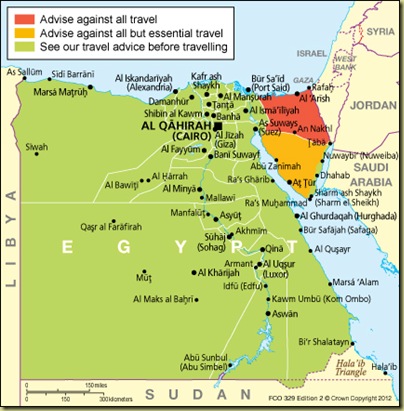
Web

“There is a high threat from terrorism throughout Egypt. Although security is tight throughout the country, especially in resort areas, there remains a high risk of attacks, which could be indiscriminate, including in public places frequented by expatriates and foreign travellers such as hotels and restaurants”

and hence it is understandable that tourist numbers are dropping fast. My roommate on board received a very anxious phone call from his wife (who had seen the revised warning) asking if it was really safe for him to be there. We, however, saw no signs of trouble and were welcomed enthusiastically (of course we were in the green part of the above map).

The flight was straight forward and the airport was more chaotic than expected with very long queues to get our visas stamped. We were coached from the airport and quickly arrived at our boat which was moored in the main marina area of town. It turned out there were only 16 on this trip (the boat can take 20) and once all had arrived, we received the standard boat safety briefing and then supper.

The marina was quite impressive – busy (over

Hurghada Marina

60 boats, some of which looked very expensive) and with lots of people, both Egyptian and tourists, obviously on a relaxed holiday. It was noticeable that the port was well maintained and very clean.

Hurghada Mosque and Town

the main mosque with the town to the right

The layout and prosperity of the area was perhaps that which Port Ghalib down at
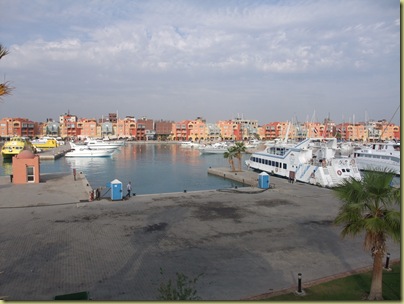
Hurghada Marina Restaurants

restaurants and bars line the ground floor of the buildings at the back of the marina

Marsa Alam aspires to copy but it is a long way away from achieving it.

And so some 13 hours after I closed my home front door, I opened the door of cabin 3 on the Sea Serpent, ready for another week’s diving.