Monday, 17 August 2009

Another landscape wonder and the Weather changes

Australia Map Freemantle

Having had eight weeks of unbroken hot dry weather, rain everyday has come as somewhat of a surprise. We had our first rain at Monkey Mia and since then there has been rain everyday, and when we were at Greenough, we thought the wind was going to blow the van roof off. Luckily the weather has not been terribly wet and if it were, most Australians would cheer because of the drought in the South. When it does rain however, it does it with monsoon enthusiasm, not a soft English drizzle. If this unseasonal rain intensity continues, we may have to change our plans slightly since some walking was planned post Adelaide, and this type of rain is not really rain for walking in.

It is of course winter in Australia and therefore we have no right to complain but it has meant that long trousers, socks and shoes have made a reappearance and our shorts etc have been put away, hopefully only until we start heading north again in a few weeks time.

On the way down south we stopped off at Cervantes to see the Pinnacles. These are thousands of limestone pillars ranging in size from small to

Pinacles 1

many metres tall which were discovered when the wind blew away the

Pinacles 2

sand protecting them. The resultant National Park is very well laid out and

Pinacles 3

is well visited. One can only be surprised that nature has created such a wonder and pleased that one can wander around it at will (although the behaviour of some of the tourists made us wonder how long that would continue) and you leave with a feel that one had been somewhere quite unique.

Fremantle is a separate city to Perth although they have merged into one suburban sprawl. Being so far from anywhere else, it has its own character and despite a somewhat fraught drive into and through the town (so much traffic, lots of people, traffic lights even) we can see that the town has a unique character which we are determined to explore.

Much of the original architecture remains in the city

Fremantle 1 

Fremantle 3

Fremantle 2

Fremantle has converted its old jail (only closed in 1991) into a tourist attraction, such a recent closure means that what you now see is what was endured by the prison population until recently.

Jail 1

Jail Cell 

A cell as was in 1860

Jail 2

Wing Landing

 Gallows

The actual gallows from which 44 prisoners departed.

Fremantle also has a very good Shipwreck museum which not only details many of the ship wrecks that lie along the west coast but also tells the story of how the west and north coasts of Australia were discovered and also explains early theories of its existence, including the Roman one that the earth was round and therefore something had to exist down here in order to balance the weight of the land at the top of the earth.

On the way here the van developed its first fault with a warning light appearing. Despite believing (thanks to Dedman Garages) that it was simply an advisory that the cam belt needed changing, it was good to hear from the van hire people than the van was not going to die within a few miles.

Friday, 14 August 2009

Pat Greenhough visits Greenough

On the West Coast below Geraldton is the hamlet of Greenough and so we went there to let Pat reclaim her birthright In the mid 1800s, Greenough was a thriving community situated close to the coast (with a dramatic sea

Sea 1

Sea 2

at high tide) on a fertile plain. It started to decline however from the turn of the 19th Century due to a combination of natural disasters and over farming. It is also a very windy area and is famous for the fact that most of the older River Gum trees (a type of Eucalyptus) are now bent double.

River Gum Leaning Tree

The hamlet was named after the sponsor (Lord Greenough) of the expedition which discovered the area and there is no evidence that he ever visited the place. The Australian National Trust have taken over a lot of the old buildings and restored them and created a rather nice “time capsule” of pioneer life (plus a very good cafe serving extremely good food).

Greenough School 1 Greenough School 2

The School and classroom.

St Catherines Hall

The hall used by the community for social events etc

 St Peter's Church

St Peters Church (one of three in the community)

Police Station

The Police Station / Court / Jail / Police Lodgings and more

Police Station 1

Rear of the Police Station and exercise yard for prisoners

Court Room

Court Room

Prisoner's Toilet

Prisoners Toilet (“a twin nettie”)

Police Stables

Police Stables

Kitchen of Police Station

Living Accommodation for police officers

Although these can be thought of as only a set of old buildings, the way they are furnished and the way the contents are explained, gives one a very good idea of how the early pioneers lived.

There may be no link between the town and the maiden name, but it was a fun place to visit and we had a very interesting time there.

Echidnas and Galahs

Sam, whilst we were out today we saw an Echidna. It behaves and walks just like a hedgehog and is covered with sharp spikes. They love to eat ants and termites, they have no teeth and break open ants nests with their front paws, they then stick in their nose (snout) and catch the ants using their long sticky tongue.

Echidna on the move

It rolls up into a ball when it feels threatened. Ask Dada to tell you

Rolled up Echidna

about the Echidna he saw at Sydney Zoo with Nana and Papa a few years ago. We also saw some very colourful birds called a “Galah”.

Galah

These two were sitting on top of a very tall rock and waiting to have their picture taken,

Wednesday, 12 August 2009

Camp Life and going down the West Coast

Australia Map Kalbarri 

We are now at Kalbarri, half way down the West Coast.

All camp sites seem to have their distinguishing features and Pat has been keeping a running score chart of them from day one. In the years to come, we will remember them for the individual characteristics such as:

  • wallabies (or frogs) in the toilets;
  • terrible red dust that always followed us into the van;
  • a very nice camp atmosphere with a camp fire;
  • official (or unofficial) entertainment;
  • toilets that you dare not use;
  • very clean showers;
  • a very efficiently run campsite;
  • etc etc

One thing that is a constant is the interchange of information between travellers. There is usually a swapping of route information and often advice as to where to stay, where not to stay and most importantly, when it is advisable to book ahead. Whilst doing so reduces your ability to decide on the spur of the moment to stay on for an extra day (or leave early), it does mean that you do not arrive somewhere only to be turned away at the door. This is certainly a possibility in North Western Australia, an area which seems to be extremely popular with campers.

Another is voluntarily offered help in overcoming a problem such as a leaky bucket - “take (and keep) one of mine, I have three” said our neighbour at one site. At another site, our neighbour apologised for coming back three times with different remedies to deal with the after effects of biting sand flies (emu oil was the best of these remedies although what part of an emu the oil came from, we are not sure).

We often meet again people we have met at other campsites and eventually there is an exchange of phone numbers, addresses, emails etc and offers of “if ever you are in our area…….”

We have met large numbers of people who have sold up and taken to life on the road and it is no longer unusual to hear talk of a house being sold (or if lucky, rented out) and plans to travel with the weather (north in winter, south in summer) until their health gives out or something happens to end their nomadic life.

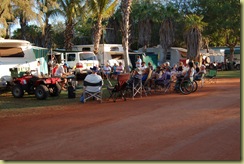
Some travellers are extraordinarily well equipped. We met one who had
Campsite Entertainment

his electric organ in his caravan and with other similarly well equipped travellers, gave an impromptu concert one night, another who had brought that most essential camping item with him, a pressure washer to keep his car clean, and another who had his garden rake with him (plus a special rack on the outside of his caravan to hold it in).

Quite a lot of travellers seem to be moving from one job to another as they travel. When they arrive somewhere, they seek a temporary job in the area or the campsite or even work for free in return for meals and a free place for their caravan – this later option is known as WWOOFing (Willing Workers On Organic Farms) and apparently is something that we (as foreigners) are eligible to do without incurring visa problems.In many cases the definition of an organic farm is very broad and this is definitely an option for the future.

Every Australian we meet at camp sites seems to say “How you doing?” when they see you. We are not too sure what the answer is expected to be and probably cause some amusement by our detailed response since we do not want to appear rude by simply responding “OK”.

In all of our travels so far, we have met only one negative Australian who complained about everything and everyone, All others have been cheerful, determined and friendly and seem to be far more active and positive in outlook than many of the same age group in the UK.

On the way South

There now follows a melange of different places, things, and views etc on the way down to Perth.

Having left Monkey Mia, we called in at Shell Beach (about 50 kms away) which gets its name because? – yes it it made up of shells, billions and

Shells on shell beach

billions of Cardiid Cockles. Individually, these are less than 1 cm in size, so image how many there must be on a beach which is as large as this:

Shell Beach

Because the sea water is very salty here (the bay is shallow), few fish live in the bay and the cockles thrive. Over time, they become fused together

Shell Quarry

like concrete blocks (known as Hamelin Coquina) and therefore over 100 years ago, the solid shells were cut into blocks and used to build houses in this area.

Just round the corner at Hamelin itself, lives a group of the oldest living creatures on earth, some 3.5 billion years old. Stromatolites were thought to be extinct until they were rediscovered in 1954. A stromatolite is a

Stromatolite

layered limestone rock which is created by a single celled organism called a cyanobacteria, Pretty unimpressive you might think until you find out that one of the by products of the bacteria is oxygen (can you see the bubbles in the water in the picture above) and they were responsible for raising the oxygen levels on Planet Earth from very low to the current 20% over a few billion years.

To see these creatures, you go out into the sea along a raised platform at

Stromatolite viewing

the Hamelin Telegraph Station (one of the most eccentric places we have visited in Australia) which is in itself, a testament to the strength and determination of the early pioneers.

For the past seven weeks, we have been driving through the Outback and have got totally used to brush, sandstone cliffs, burnt scrub etc etc. About 200kms after leaving Monkey Mia, the landscape suddenly changed and

Green Fields

we were seeing green fields with crops in them and endless swathes of

Wild Flowers

wild flowers not only along the road side but also stretching off into the distance. It took some getting used to after the bush and dessert and

Wild Flowers

looked quite like a large English countryside in many places.

We went to Kalbarri (about half way down the west Coast) because someone said we should not miss it. It is a large (by Australian standards) town at the mouth of the Murchison River. An indication of the youth of Australia is that It had its first permanent resident in 1945 and its first shop in 1954. Now it is quite full of nomads all year round because of its mild climate and also surfers because of the superb waves.

Breaking Waves at Kalbarri

Surfer

Pelican feeding time is one of the daily attractions on the beach and has

Kalbarri Pelicans

been going on for at least 15 years when the Pelicans fight the seagulls for food. Guess who gets asked to help?

Pat the Pelican Feeder

The town also has a wild flower centre with samples of the flowers you can see across Western Australia, many of which are very colourful.
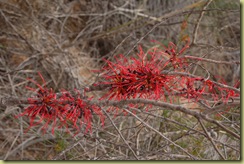
Bird Beak Hakea

Bird Beak Hakea

Wheat Belt Wattle

Wheat Belt Wattle

Purple Thrypton

Purple Thrypton

Kangaroos Paw

Kangaroo’s Paw

Common Smoke Bush

Common Smoke Bush

The weather has certainly changed now, most days now contain numerous short periods of very heavy rain and it has almost become long trouser weather. We expect that by the time we get to Perth, we shall have had to get out the winter clothes for at least the coming few weeks until we head up towards Alice Springs.

Monday, 10 August 2009

Pat feeds the Dolphins at Monkey Mia

Australia Map Monkey Mia

On the way to see the Dolphins

Tropic of CapricornThe 582 kms of road from Exmouth to Shark Bay on the way to see the Dolphins of Monkey Mia take us past a few interesting places which deserve more time than we can spare them. We also cross the Tropic of Capricorn which marks the most southerly latitude at which the sun can appear directly overhead at noon. This event occurs at the December solstice.

There is also a new road sign warning us to be careful of an animal, some

Bilby Sign

research revels that this is a Bilby – a shrew like animal that only comes out at night, hence we are unlikely to see one or be a danger to it. One event of major note for us is that during the night we get our first rain for 8 weeks and also find that the roof of the campervan has a small leak.

A pod of Dolphins have got into the habit of coming to the beach at Monkey Mia every morning for part of their daily food requirements and thus have become a major tourist attraction and there are few visitors to this area of Australia who do not go to see them. The dolphins which come are into their fourth generation and often all generations are on the beach.

A very popular camp site has been set up on the beach where the dolphins come and In order to protect them from tourists, the “interaction” (as it is now known) is managed jointly by the camp site and the state Wildlife Protection Agency.

Monkey Mia Resort

7.30 am sees us down on the beach edge as part of a line of about 200 people waiting to meet the dolphins. They choose to come (or not) and

Explainer and Dolphins

when they do, they are introduced to us by an explainer who gives quite a detailed explanation about them, their life, their history and how they are managed (and protected from tourists). The explainers can identify the dolphins individually and know whom their parents are, their life history, their peculiar behaviours etc. Up to 22 dolphins have been known to come to the beach, we saw about 12.

People are picked out at random from the beach edge and invited to come into the water to give a fish to a dolphin – managing it this way means that no dolphin gets more that 1/3rd of its daily food requirement from direct feeding and they have to hunt for the rest.

Pat's Dolphin

The explainer in front of us pointed to a lady in the crowd and said “would the lady with the beautiful dark eyes like to come and feed this dolphin

Dark Eyes come on down

and so Pat is one of three people chosen to go down into the water and feed this dolphin.

Was she excited? Decide for yourself

There are also a number of Pelicans who live near the beach.

Pelican in Air

“A curious bird is the Pelican, it beak can hold more than its belly can”

Pelican two

Pelican

Although this is a major tourist attraction, it is surprisingly well managed and one does not feel processed. The scenery in the area is very beautiful

Shark Bay

and it is certainly a place where you can relax.

 Paul at Monkey Mia

In the evening, we went to a most interesting lecture on the relationship between the Tiger Shark and Dugongs and Green Turtles given by one of a group of graduate students carrying out marine research at the resort.