Wednesday, 19 February 2014

A few days in Amritsar: The Temple

Two of the things that Amritsar is famous for is The Golden Temple and the nearby border post with Pakistan at Wagah. During our short stay here, we are visiting both of these but we are with a Rotary Group and therefore it never proceeds exactly as planned because it is assumed that we will always want to see Rotary activities in the area.

So during breakfast we find out that we are visiting a school that morning which has been supported by Rotary in the past. But before the school, we are going to the Maharaja Ranjit Singh Museum and Panorama.

Maharja Ranjit Singh Panorama Pavillion


The Maharaja was a local ruler who was also responsible for the gilding of the Golden Temple.

Although many of the paintings are hung too high for easy viewing, they give an impression of India

PH Lahore Elephant


during his reign. In this picture, he is riding an elephant through the streets of Lahore. Two boys threw a stone at a tree with sweet fruits hanging on it, but hit the Maharaja. He forgave them and gave them gold coins.

Beautification of Jwalamukhi Temple


This picture shows the “Beautification of the Jwalamukhi Temple” which is said to show his willingness to support other (hindu) religions. And finally,

Acquistion of Diamond


his acquisition of the Koh-I-Nor Diamond which eventually came into British hands.

There are numerous panoramas in the museums

MRS Gilding of temple


this one shows him supervising the gilding of the temple, 

Fall of Multan


and this one, the Fall of Multan in 1818.

Sri Guru Harkrishan Senior Public School

In the past Rotary have contributed equipment to the school and therefore we were invited to the school not only to see the equipment, but also because it was the last day of term and the graduating students had arranged a performance.

School entrance


Although called a senior school, it had a junior wing.

Junior school classroom 001


One characteristic of Indian schools seems to be a love of "bon mots” - hence there were numerous such around the school including

Motto 001


The pupils were very well behaved and by UK standards one would say that the resources were sparse and old.

Performing 001


The graduating students danced, sang

School Stage Party


and were presented with certificates for numerous interesting attributes such as Mr Handsome, Ms Forever Happy…...

The Golden Temple

PH guide map of golden temple amritsar


The historical relationship between the UK, the Golden Temple and Amritsar is not one of which the UK can be proud. However we were welcomed wherever we went, albeit with some curiosity because there were few other western tourists there.

The Golden Temple is regarded as the seat of the Sikh religion, it was built in the late 1500s and was not always gold. A synopsis of its history can be found here and here (this site offers a downloadable guide book). Turning the temple into the Golden Temple was done by Maharaja Ranjit Singh and it looks very impressive.

We went thereto the Night Ceremony to see the Sikh holy book (Guru Granth Sahib) carried to its night time store and then the following day to see around the temple and its kitchens. The pictures are therefore a mix of day and night.

Remove Shoes at Temple


Going into the temple requires you to remove your shoes,

Headscarf at Temple PRH


Headscarfe at Temple PMH


wear a headscarf

Washing Feet at Temple 001


and wash your feet by walking through a pool of water

PH Entrance to temple


and then through the pilgrims entrance into the temple.

Golden Temple at night


Once inside, it is truly magnificent. At night the Golden Temple looks magnificant

Temple pool at night


as does the Temple Pool. Chantings from the Guru Granth Sahib continue on a 24 hour basis

Holy Book being read at Temple


at more than one point in the temple

Temple video screen


and the current words being chanted appear on large video screens. 

At a particular time every evening, the Guru Granth Sahib is carried 

Book appears from Temple


Book in carriage leaving


across a marble causeway (Guru’s Bridge)

Entrance to Temple walkway


and out through the Darshani Deorhi - a magnificent gateway building / door

Temple store at night


to the Akal Takht where it rests in state overnight.

Pat and Paul at Amritsar


By day, one gets a better feel for the size of the temple

Golden Temple 001


the beauty of the buildings

Ornate Building


the ornateness of the architecture

Marble inlay Patterns


and their decorations

PH Ornate Ceiling


and ceilings

Paul the pilgrim


Pilgrims are expected to bathe in the pool

PH Pilgrims Swim


and many do, some more than others

Ladies bathing


PH Ladies Dip Amritsar


and a separate enclosed area is provided for females.

The temple is also famous for its kitchens and the fact that they serve over 20,000 people every day free of charge. It is industrial catering on an enormous scale and all of the labour used is voluntary.

Tea Wallah


cups of rather sweet tea are available to all

Pat drinking tea


including Pat

Chapatti 3


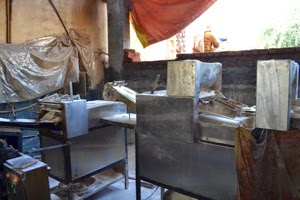
Chapattis are made in 1000’s per hour

Chapatti 4


Chapatti 6


Chapatti 7


they are sorted and checked by a team

PH Chappatti Team


Chapatti 8


 and some quality control is personal.

Chappatis from Kitchen


When they have passed, they get trundled off to the dining hall.

Kitchen Garlic peelers


Whole families volunteer to peel garlic,

Kitchen Vegetable peelers


or vegetables

Kitchen plate clearing


or clean plates

Cutlery Kitchen


or hand out clean plates and cutlery

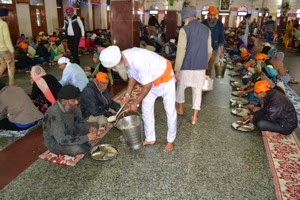
Kitchen serving food


or dole out food

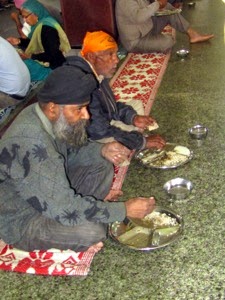
PH Pilgrims Eating


to anyone who sits down.

It is an impressive and a superb example of religion relating to its community and of voluntary involvement.


Tuesday, 18 February 2014

A few days in Amritsar: Day One

Amritsar Map

Although we are off to India again to take part again in a Polio Immunisation, we are going a few days early in order to go to Amritsar to see the Golden Temple, the Wagah Border Ceremony and to travel back to Delhi by train for the immunisation events.

The process of getting a visa for India is the same pain as it was last time, although the cost has gone up considerably. Visa fees seem to be set on a tit-for-tat basis. Whenever the UK changes its visa fees for Indians seeking to come to the UK, the Indians retaliate by changing theirs to match. So they charge us £80 plus fees (total cost around £110) and we charge them 8400 Rupees plus fees. The actual time it takes from posting off the forms to getting our passports back is only 5 days. The system is very efficient and provided you complete the four forms correctly and do everything as exactly as specified, it is relatively easy.

We are flying on Jet Airways which does not have the greatest of reputations for comfort and quality. However its flights meet our criterion of departing and arriving at a sensible time at each end both there and back and on the way out we “simply" (not a word which India usually manages and in this case, a word we regard with suspicion) change planes within the same terminal in Delhi for the flight to Amritsar.  

Purple Parking

And so after my regular Monday Rotary lunchtime meeting, we find ourselves putting bags into the car for the longish drive around the M25 to Heathrow. The Tube system has been going through one of its regular "strike / threat of strike" moments and we cannot assume that they will be running when we get back - hence the drive to the airport and making use of a really cheap deal with Purple Parking on a bright Monday afternoon (a contrast to the months of heavy rain we have had in the past few months). 

Flight Route to Delhi

The flight is better than the reviews had led us to expect, queues at Immigration are thankfully very short because strong tail winds enable our arrival to be earlier than and hence before numerous other planes scheduled to arrive at around the same time and our baggage appears on the belt without too much of a wait. As we had suspected, “simply changing planes” is not simply. The seasoned air traveller knows that the last thing you want to do when changing planes is to go “landslide” during the change because then you have to go through the whole process of security and its associated queues again. However we are all directed to go landslide (along with about 100 other passengers) and have the pleasure of an Indian style queue through baggage security and then personal security and its queues and searching (which the Indian system does very thoroughly). The flight to Amritsar is short and arrives only 15 minutes late and we are disgorged into the wonderful mayhem

Chaos of India

and contrasts of India.

 Donkey meets Lorry

Driving down roads where horse drawn vehicles meet lorries and

Traffic Contrasts

Auto Rickshaws (we always called them Tuc Tucs  but were constantly told that they were really auto rickshaws) are fighting for customers with Pedal Rickshaws.

Adjacent to our hotel is a shopping mall - something which we have never before experienced in India. Having passed through security and been throughly frisked, we are inside a building which looks just like a shopping mall anywhere in the world. Although around 1/3rd of the shops have yet to be occupied, what is on sale in them and the type of customers we see in the mall are typical of the new wealthy working class in India. Prices are high by Indian and low by British standards.

Mall 1

If you want to, you can eat at a Subway or buy a Domino’s Pizza - and judging by its popularity, many Indians do want to.

Mall 3

Mall 2

The supermarket sells a wide range of prepackaged products whose equivalents would be found on any British supermarket shelf.

This is a marked contrast to the shops just down the road, the type which is used by the majority of the Indian population,

Roadside Shop

or this roadside drinks vendor (sugar cane juice)

Roadside Drinks Stall

people patiently waiting for the next person wanting to buy firewood for cooking their meals (hence the thick pallor of smoke hanging over the city),

Firewood Sellers

and the building work everywhere throughout India.

Building work everywhere

Paraphrasing what our local guide said when we arrived: "It is our endeavour to provide you with the most fulfilling experience in this special destination filled with peculiarities not found anywhere else in the world. Be prepared to be impressed, bewildered, fascinated, thrilled, inspired and amazed. How you react is entirely up to you, but it may help to keep a few tips in the back of your mind. One, be patient. Things don’t work the way they do back home and sometimes they don’t work at all. Two, be open minded. The more flexible you are, the easier it will be to enjoy your yourself. And three, don’t worry about solving or understanding the phenomenon around you."

Welcome to India!


Rotary and Polio in India

Rotary wheel transp thumb1
This and the next few blog entries, record our participation as Rotarians in the National Immunisation Day (NID) in India in February 2014. They are written with fellow Rotarians in mind, particularly those who might be thinking about taking part in a NID sometime in the future (if there are any more).

There is also a link to the blog we wrote in 2013 when we went to Baduan in Uttar Pradesh to take part in the February NID there. 

For those unused to navigating blogs, look to the right of this page in the February 2014 section and you will find a number of entries – if they are not showing individually, then click on the word February and they should then show at the bottom of that months’ list of blog entries. Alternatively, you can get to the other entries by clicking on the appropriate “here” in the list below.

  • Pre-NID activities is Ghaziabad click here
  • Vaccination Day click here
  • Follow-up Day click here
  • 2013 NID in Baduan click here

When we returned from India we were interviewed by our local Talking Newspaper. You can listen to the interview by clicking on the appropriate box below. Each part of the interview lasts about 15 minutes.

Talking Newspaper Interview Part 1


Talking Newspaper Interview Part 2


Progress in Eradicating Polio

The global eradication of Polio has been a constant theme for Rotary for more than 40 years.  You can find a concise history of Rotary and the eradication campaign on the Unicef website here and more general information on Polio here (again on the Unicef website).

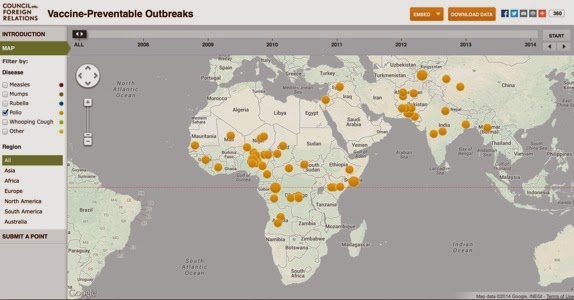
It is interesting to look at a recent timeline for Polio outbreaks. First here is a summary of all outbreaks since 2008 taken from the Council for Foreign Relations website here
Polio outbreaks 2013 
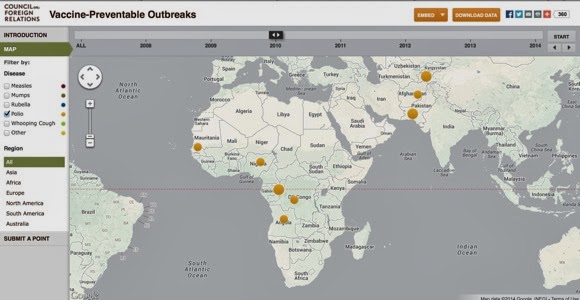
and looking at the past few years we see for 2010:
Polio outbreaks 2010


2011:
Polio outbreaks 2011
2012:
Polio outbreaks 2012
2013:
Polio outbreaks 2013

Whilst the total number of cases is small, Polio shows its resilience by constantly popping up because of a cross border infection in certified polio free countries or in small numbers in the three remaining endemic countries.

Although India recently passed the important three years date since its last case of endemic Polio, the constant threat of Polio reappearing from two of the three countries where Polio is still endemic - Pakistan and Afghanistan (they share borders with India) is sufficient to ensure that the Indian Government cannot say “problem solved, let’s move on to the next issue”. Because of this, the Government still organises a number of National Immunisation Days (NIDs) when the objective is to vaccinated all 173 million children and a few SubNational Immunisation Days (SNIDs) which focus on high risk areas.

And so, every year Rotarians from across the world go to India to assist in NIDs and SNIDs. The contingent from the United Kingdom are always led by two unsung heroes - Mike and Bernice Yates and it is to them that I dedicate these blog entries.

Sunday, 1 September 2013

Post trip generalisations

How easy (or otherwise) was it buying fuel for our RV?

We never had any problems in obtaining fuel and rarely did we drive more than 30 miles before we passed a gas station. The most isolated region seemed to be parts of Utah. Gas was usually available in the very large National Parks (such as Yellowstone) but it was quite expensive.

Many gas stations had loyalty card schemes and whilst it is worth joining them, it is not worth driving out of your way to use them. Using the GasBuddy website saved a lot of money (see the blog entry here on buying gas in the USA using a European or non American Credit Card).

We had to look out for LPG because many gas stations did not have it but there was never a problem finding one that did – we just waited until we passed one on our planned route. Many camp sites sold LPG.

What was driving an RV like on American roads?

Our RV was 25ft long and driving it was quite easy other than that parking it could prove difficult because of its length. There were a number of occasions when we could not park where we wanted to visit because there were no parking spaces large enough. Parking over two bays seems to be accepted practice for large vehicles (although it seems you only pay for one if there are meters). Maybe were lucky never to pick up a ticket. In a few places we visited, we ensured that we got there very early in the morning in order to be able to park. A 22ft RV would have been far better – in fact we ordered a 22ft but when we went to pick our RV up, they had “run out” of our preferred size.

American drivers do not understand flashing headlight etiquette (and only rarely do they acknowledge when you may have done something to aid their driving) when you overtake or when you have been overtaken so we stopped using or expecting it.

Turning right on red seemed to be allowed everywhere unless otherwise indicated. Being undertaken could be a shock and we constantly had to look out for it. Other than in the cities, there was far less tailgating and aggressive driving than in the UK. In the few big cities we went to, driving standards were as bad as anywhere in the UK.

It is worth using a GPS in the USA?

Our GPS (TomTom satnav) was absolutely invaluable and navigation would have been very difficult without it. Using it was simple provided we had the full address of where we were going to (otherwise sometimes we had to settle for the location of “city centre” and then sort it out when we got there). We chose the “computer voice” rather than the “human voice” because that one could tell you the name of the road you were looking for and that was useful. Occasionally it got lost and told us to turn onto a road which was not there so we always treated its commands with a certain amount of caution.

We had a general road atlas and also picked up free large scale State Maps from “Welcome Centres” whenever we got to a new state because these gave quite a good detailed view of the State and its roads. Seeing where you are going on a map is always helpful and relying on a satnav only can be a disaster.

Speed limits on roads constantly changed and keeping track of the actual speed limit at any particular spot was difficult. Sometimes the GPS statement of what the speed limit was at a particular spot was wrong.

We saw lots of drivers being stopped (Oregon seemed to be the worst for this) and given tickets – we kept to at least 5 and usually 10 mph below the limit in order to avoid a ticket (it worked).

Some roads have minimum speed limits which you have to remember as well as the maximum. Unmarked police cars are very common.

Camping and RV Parks

We joined Good Sam and KOA and hence got a 10% discount at many campsites. This definitely saved us money. Most KOA campsites seem to be more expensive than non KOAs and were not necessarily better than non KOAs although booking a KOA was simplicity itself (freephone or Internet). There did not seem to be any relationship between how much you paid and how good or bad a camp site was.

The number of RV camps throughout the USA is astonishing and we found much more choice than we had expected. There are a lot of RV camps which do not have websites and / or are not in directories.

However, it was impossible to find an RV park near Chicago so we stayed in a hotel close to the airport which had a large external car park and used the Metro to get into town. This was very easy. Similarly, there are very few RV camps in Los Angeles.

There are numerous state parks throughout the USA where camping in an RV is very cheap. Usually they have no power but often have water and most times have a long drop toilet. If we were to do a similar trip in the future, we would make more use of them.

Other than the very popular areas such as Yosemite, Yellowstone, Malibu and a few others, we had no problems reserving a campsite place on the day or the day before we needed it. From mid August onwards every campsite we visited (other than a few national parks) had plenty of spaces available because the schools had gone back.

Buying Food and Drink

Finding supermarkets was never a problem although finding good quality fresh food was an issue. We were surprised at how poor the quality was in some of the largest supermarkets – in general small supermarkets had fresher food. Big food shops were open seven days a week, usually very long hours and often 24 hours a day,

Decent bread was impossible to find – only one supermarket we went to had what we would call “good tasty bread” and we found only one specialist bread shop.

In one state I had to produce proof that I was aged over 21 before they would sell me beer. I did not realise that at 63 years of age, I look like a teenager! They said “everyone has to prove their age”.

Some states do not charge SalesTax and we often saved quite a lot of money by stocking up in the Sales Tax free state before we crossed a state border.

Mobiles phones in the USA whilst on the road and staying in touch

We purchased a Virgin Mobile Phone for emergency use and to phone camp sites and it turned out to be not as good as we had be told in the store. Coverage was quite limited outside of urban areas and there was a period of 2 weeks when we could get no signal at all when we were in Montana, Wyoming and South Dakota.

AT&T seem to have the best coverage and an AT&T PAYG sim card may have been a better purchase even though its call charges would have been slightly higher.

Only one of the three mobile phones we had with us would work in the USA because it is a tri-band country and two of our UK phones were bi-band, Strangely, we do not remember having this problem the last time we were there – maybe technology has changed. Our UK sims cards worked if we put them in our tri-band phone but the cost of making and receiving a call on a UK sim card was very very high and so our friends were encouraged to use email.

When our mobile phones were not working and we wanted to make a phone call, we found that if we asked in a store “can you tell me where the nearest phone is? My British mobile phone does not seem to work here and I want to make an 800 (or sometimes a local) call?” they would invariably hand us the store phone to use. This really surprised us and was most welcome. The definition of a local call seems to be one with the same area code and 800 free phone calls apply to any phone number where the area code begins with an “8”. Sometimes we had to put a 1 in front of the area code and sometimes we did not – we never worked out how to get it correct first time.

Internet connectivity was surprisingly poor at most camp sites throughout the USA. It seems to be due to a lack of bandwidth (in one town we stayed in, the new superfast 5Mb service was proudly being advertised) and as soon as the campsite gets busy and evening comes, everyone is using WIFI and no-one can get any reasonable response. We learnt to grab any connectivity we could get at any time of the day. No doubt if we had purchased a US data package life would have been easier. A number of cafes and fast food places had free WIFI.

The cost of data roaming on a UK registered mobile phone in the USA is extortionate – do not even think of trying it.

Odds and ends

Some over the counter (OTC) drugs are much cheaper in the USA than in the UK and others are more expensive, it is probably better to bring them with you.

The USA is shamefully bad at recycling and the only place you could be sure you could recycle was in a National Park.

American TV is terrible. The only time we found anything decent to watch was when we could get a Public Broadcasting Service (PBS) channel. Our van had a normal and a digital TV aerial but it rarely picked anything up. Some campsites had cable but the first sentence still applies. UK DVDs will not play on American DVD players so it is not worth bringing any with you unless you know they are “area unrestricted”.

We paid for as much as possible using credit cards (we had a couple of the UK “foreign transaction commission free” cards) and quite often we had to produce some ID to use the card – our signature was not sufficient. Other than at ATMs, we never used PINs in the USA, they do not have the technology although there is talk of them being introduced in a few years time.

There are ATMs everywhere and it is useful to have a couple of debit cards just in case the machine swallows one card. On the one occasion we got cash from an ATM at a proper bank, we got a very bad rate of exchange  - $1.44 to £ as against the $1.55 we were getting on our credit cards. The rate we got for $ in the UK before we left was far better than that on offer anywhere in the USA.

Whilst we always were careful about our personal security, only once did we feel uneasy and then we made a speedy departure. We did find statements made by some of our fellow campers “of course we have a gun in our RV / handbag / bedroom / car” a little unsettling although no one ever produced one to show us.

The National Parks Service is superb and usually offered a range of ranger led activities throughout the day. We purchased an $80 one year America Pass which proved to be good value because we visited a lot of parks.

We went through four time zones and therefore had to be aware of when it changed. The clocks going back when travelling west was never a problem because we just had more time to get to where we were going but the clocks going forward an hour when travelling eastwards meant we had to be aware of the time in our destination. Arizona was a catch out because although in the Mountain Time region, it observes Pacific Standard Time. A helpful check was to say “what’s the time with you now?” when we were booking a campsite somewhere where we suspected there was a time change.

All of the above comments are of course generalisations but they reflect what we experienced. 

How did we plan the trip?

Many dark wintery nights were spent working out a draft route which:

  • visited all of the places we would like to go to;
  • had few really long days driving;
  • got us to certain places on set dates;
  • enabled us to determine the date we would be at some places; and
  • had sufficient space in it to allow us flexibility.

It also had to take into account Independence Day and Labour Day when much of America goes on holiday.

Explaining some of these planning constraints in more detail:

  • we wanted to go to the Deadwood City Rodeo which is held only on the third weekend in July;
  • visit a couple of friends en-route and it is only fair to them to let them know when we were going to arrive etc
  • whilst much of the time we could just turn up at a camp site or phone earlier in the day and expect to get a pitch, there were some places where that is guaranteed impossible. For us, these include Yosemite (reservations open in mid February), Yellowstone, Custer State Park and a few more.

So we have had to plan a route which enabled us to say with certainty, “we intend to be in Yellowstone from X to Y” so we could book a pitch as soon as bookings opened.

We also knew from experience that along the way it was highly likely that we would want to stay somewhere for an extra day or go and visit somewhere we had just heard about.

To do this we needed space in the plan and the ability to adjust the plan as much as possible.

Devising a route and plan which coped effectively with the above took a long time but eventually it resulted in:

Planned Route

The total distance of the above was just over 8000 miles so we were expecting our final distance to be around 10,000 miles allowing for diversions and all the other little trips which soon increase the distance.

The principal places we wanted to visit were:

Getty Museums in Los Angeles CA
Hurst Castle San Simeon CA
Yosemite CA
Bodie Ghost Town CA
San Francisco CA
Bodega Bay CA
Walla Walla WA
Glacier National Park MT
Craters of the Moon National Park ID
Grand Tetons National Park WY
Yellowstone National Park WY
Little Bighorn MT National Monument
Deadwood City SD
Mount Rushmore SD National Memorial
Chicago Il
Columbus In
Arthur IL
Springfield IL
Oklahoma OK
Amarillo TX
Holbrook AZ
Winslow AZ
Arches National Park UT
Las Vegas NV

and of course there were lots of other places in between the above which we saw on the way.